
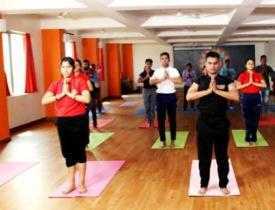
Description
Course Name: Diploma in Yoga Education
Course Id: DYE/Q0001.
Eligibility: Completion of 10th Grade (high School) or equivalent.
Objective: The Diploma in Yoga Education is designed to provide students with a thorough theoretical foundation in the philosophy, psychology, and educational value of yoga. The course aims to cultivate an academic understanding of yoga as a holistic discipline rooted in ancient Indian wisdom and relevant to modern educational systems.
Duration: Six Months.
 How to Enroll and Get Certified in Your Chosen Course:
Step 1: Choose the course you wish to get certified in.
Step 2: Click on the “Enroll Now” button.
Step 3: Proceed with the enrollment process.
Step 4: Enter your billing details and continue to course fee payment.
Step 5: You will be redirected to the payment gateway. Pay the course and exam fee using one of the following methods:
Debit/Credit Card, Wallet, Paytm, Net Banking, UPI, or Google Pay.
Step 6: After successful payment, you will receive your study material login ID and password via email within 48 hours of fee payment.
Step 7: Once you complete the course, take the online examination.
Step 8: Upon passing the examination, you will receive:
• A soft copy (scanned) of your certificate via email within 7 days of examination.
• A hard copy (original with official seal and signature) sent to your address within 45 day of declaration of result.
Step 9: After certification, you will be offered job opportunities aligned with your area of interest.
Online Examination Detail:
- Duration- 120 minutes.
- No. of Questions- 60. (Multiple Choice Questions).
- 10 Questions from each module, each carry 10 marks.
- Maximum Marks- 600, Passing Marks- 40%.
- There is no negative marking in this module.
| How Students will be Graded: | ||
| S.No. | Marks | Grade |
| 1 | 91-100 | O (Outstanding) |
| 2 | 81-90 | A+ (Excellent) |
| 3 | 71-80 | A (Very Good) |
| 4 | 61-70 | B (Good) |
| 5 | 51-60 | C (Average) |
| 6 | 41-50 | P (Pass) |
| 7 | 0-40 | F (Fail) |
Key Benefits of Certification- Earning a professional certification not only validates your skills but also enhances your employability. Here are the major benefits you gain:
Practical, Job-Ready Skills – Our certifications are designed to equip you with real-world, hands-on skills that match current industry demands — helping you become employment-ready from day one.
Lifetime Validity – Your certification is valid for a lifetime — no renewals or expirations. It serves as a permanent proof of your skills and training.
Lifetime Certificate Verification – Employers and institutions can verify your certification anytime through a secure and reliable verification system — adding credibility to your qualifications.
Industry-Aligned Certification –All certifications are developed in consultation with industry experts to ensure that what you learn is current, relevant, and aligned with market needs.
Preferred by Employers – Candidates from ISO-certified institutes are often prioritized by recruiters due to their exposure to standardized, high-quality training.
Free Job Assistance Based on Your Career Interests – Receive personalized job assistance and career guidance in your preferred domain, helping you land the right role faster.
Syllabus:-
Module 1: Foundations of Yoga and Indian Philosophy: History and Evolution of Yoga, Meaning and Definition of Yoga according to ancient texts, Introduction to the Vedas and Upanishads, Basic principles of Samkhya Philosophy, The four streams of Yoga (Karma, Bhakti, Jnana, and Raja Yoga), Understanding the Purusharthas (Dharma, Artha, Kama, Moksha), The Guru-Shishya Parampara tradition, Relevance of Yoga in the modern educational system, Concept of Chitta and Chitta-Vritti, Introduction to Patanjali’s Yoga Sutras.
Module 2: Anatomy and Physiology for Yogic Practice: Introduction to the human skeletal and muscular systems, The respiratory system and mechanics of breathing, The nervous system and its relationship with relaxation, Impact of Yoga on the endocrine and circulatory systems, Physiology of the digestive system and yogic diet, The concept of Homeostasis through Yoga, Anatomy of the spine and its importance in Asana, Understanding the Stress-Response mechanism, Impact of Yoga on the immune system, Basic biomechanics of yogic postures.
Module 3: Hatha Yoga – Asana, Shatkarma and Mudra: Principles of Hatha Yoga and its primary texts, The science of Surya Namaskar (Sun Salutation), Classification of Asanas (Standing, Sitting, Prone, Supine), Techniques and benefits of Shatkarmas (Cleansing processes), Neti, Dhauti, and Basti procedures, Concept of Mitahara (Yogic nutrition), The role of Bandhas (Energy locks) in practice, Introduction to Mudras for energy channeling, Corrective and meditative postures, Precautions and contraindications for various Asanas.
Module 4: Patanjali’s Ashtanga Yoga and Meditation: Introduction to the Eight Limbs of Yoga (Ashtanga Yoga), Detailed study of Yamas (Social ethics) and Niyamas (Personal discipline), Pratyahara: The art of sensory withdrawal, Dharana (Concentration) and its practical techniques, Dhyana (Meditation) and its psychological impacts, Concept of Samadhi (Super-consciousness), Overcoming the Five Kleshas (Afflictions), Understanding the obstacles in Yoga (Antarayas), Role of Mantra and Japa in meditation, Integrating meditation into daily educational routines.
Module 5: Yoga Education and Teaching Methodology: Principles of teaching Yoga to various age groups, Lesson planning for Yoga sessions, Use of audio-visual aids in Yoga instruction, Methods of class management and safety, Teaching techniques for Asana and Pranayama, Psychology of the learner in a Yoga class, Organizing Yoga camps and workshops, Assessment and evaluation of student progress, Communicative skills for Yoga instructors, Development of a Yoga curriculum for schools.
Module 6: Applied Yoga and Spiritual Development: Yoga for stress and anxiety management, Role of Yoga in physical and mental health, Therapeutic applications of Yoga for common ailments, Concept of personality development through Yoga, Ethical values and character building, Yoga for concentration and memory enhancement, Promoting universal brotherhood and peace, Designing personal Sadhana (Daily practice) plans, Social and environmental ethics in Yoga, Professional ethics for Yoga educators.
Job Opportunities after completion of Diploma in Yoga Education course:
Graduates with a Diploma in Yoga Education have diverse career options in India, including:
1. Yoga Instructor/Trainer
- Role: Teach yoga at fitness centers, studios, schools, or corporate settings.
- Salary: ₹15,000–₹50,000/month (depends on location and expertise).
2. Yoga Therapist
- Role: Help clients manage health issues like stress, diabetes, or hypertension using yoga therapy.
- Salary: ₹20,000–₹60,000/month.
3. Corporate Wellness Trainer
- Role: Conduct yoga and mindfulness sessions for employees in companies.
- Salary: ₹25,000–₹80,000/month.
4. Yoga Consultant
- Role: Advise wellness centers, resorts, or organizations on yoga programs.
- Salary: ₹20,000–₹50,000/month.
5. Yoga Researcher/Academician
- Role: Work in research institutions or universities as a lecturer or researcher in yoga.
- Salary: ₹30,000–₹70,000/month.
6. Freelance Yoga Instructor
- Role: Conduct private yoga classes, workshops, or retreats.
- Earnings: ₹500–₹2,000/session.
7. Yoga Studio Owner
- Role: Start and manage a yoga studio or wellness center.
- Earnings: Variable, ₹50,000–₹2,00,000+/month (depends on location and clients).
8. Online Yoga Instructor
- Role: Teach yoga through online platforms or create digital content.
- Earnings: ₹20,000–₹1,00,000/month.
9. Government Opportunities
- Role: Work in government wellness programs or as a yoga teacher in schools.
- Salary: ₹20,000–₹40,000/month.
10. Yoga for NGOs/Community Services
- Role: Promote yoga for health and wellness in rural or underprivileged areas.
- Salary: ₹10,000–₹30,000/month.
Salaries vary with experience, certifications, and the city of operation.
